€200M Wake-Up Call: Santander Just Proved AI Pays
- 15 hours ago
- 2 min read
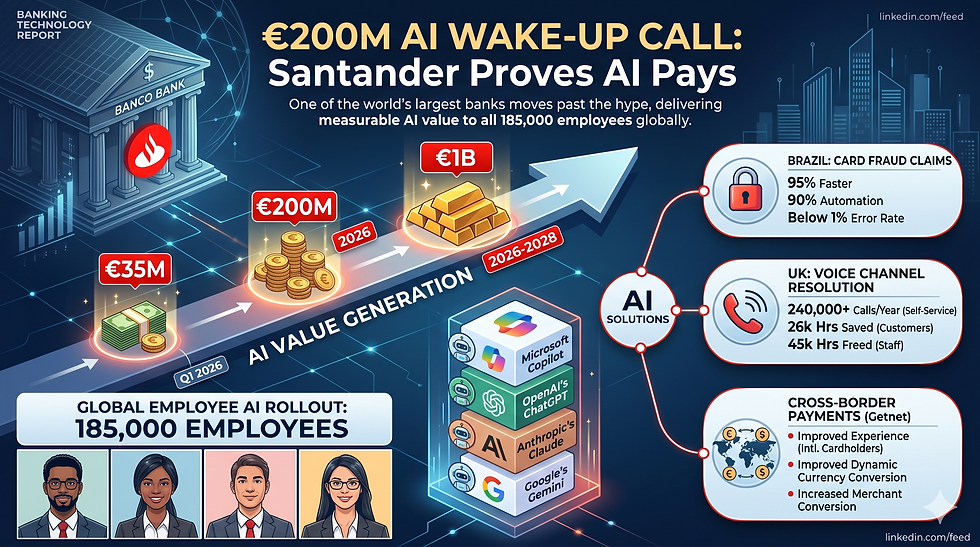
One of the world's largest banks has moved past the hype stage — and the numbers are starting to talk.
Santander is rolling out AI tools to all 185,000 of its employees globally, following a year of quiet but measurable progress. The move comes as the bank confirms it is on track to generate over €200 million in business value from AI in 2026 alone — a milestone on the way to its stated €1 billion target for 2026–2028.
The first quarter of 2026 already delivered €35 million in value, with roughly 40,000 employees actively using AI tools at that point. Now access is being extended to everyone, powered by a multi-provider stack: Microsoft Copilot for everyday productivity, alongside OpenAI's ChatGPT, Anthropic's Claude, Google's Gemini, and regional partners such as Abu Dhabi-based G42.
The bank has more than 280 AI-powered process automation agents already running in production across credit, fraud, KYC, and operations. The concrete results are hard to ignore:
Brazil: AI now handles card fraud claims roughly 95% faster, with up to 90% automation and an error rate below 1%.
UK: Santander is deploying AI in voice channels to resolve card-related queries — targeting 240,000 calls per year handled through self-service. That translates to roughly 26,000 hours saved for customers and 45,000 hours freed up for staff to focus on complex cases.
Cross-border payments: Santander's payments unit Getnet is using AI to improve the experience for international cardholders, including dynamic currency conversion — helping merchants increase conversion rates and improving the overall cross-border commerce experience.
According to Ricardo Martín Manjón, Chief Data and AI Officer at Banco Santander: the bank is not working from theory anymore. AI is already improving processes, supporting teams, and opening new opportunities at scale.
For the payments and financial services industry, Santander's rollout is more than a corporate milestone. It is a signal: the experimentation phase is closing. The institutions that treat AI as a strategic infrastructure investment — not a pilot — are beginning to separate themselves from those still debating where to start.
Source: Finextra
